
The Killing Zone Third Edition: Dr. Paul Craig Returns with 12 Years of New Data
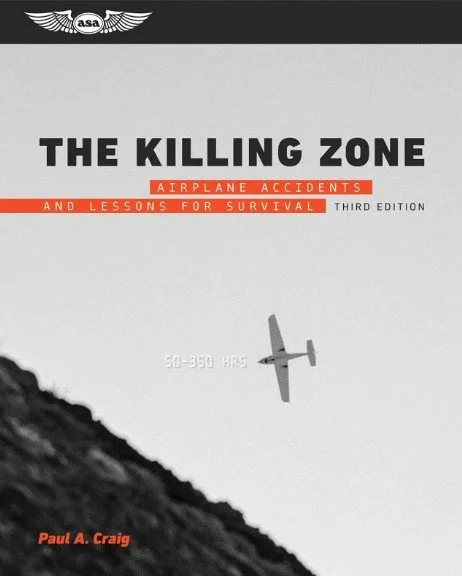
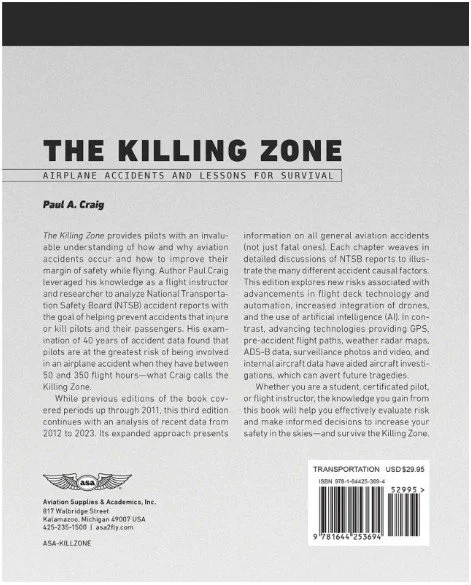
Dr. Paul Craig is back on the podcast, and he's brought some sobering news. The third edition of The Killing Zone is finally here after a publishing odyssey that saw McGraw-Hill exit aviation entirely and Aviation Supplies & Academics pick up the torch. But more importantly, Paul's spent the last several years analyzing 12,406 general aviation accidents to answer the question: does the killing zone still exist?
The short answer? Absolutely.
The Data Behind the Zone
Paul approached this research the same way he has for decades – as an educator, not an enforcer. "I'm not an administrator. I'm not an enforcer," he explained. "When we use aviation accidents as teaching tools, there's no blame. It's not like we're saying, 'Hey, this guy screwed up,' because that's not helpful."
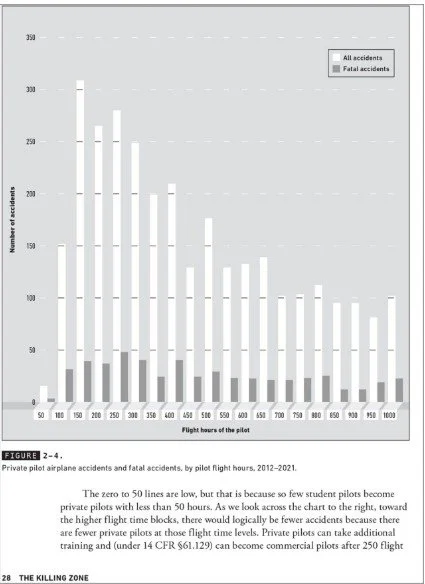
His methodology remains rigorous. Rather than relying on raw accident counts, which can be misleading, Paul normalized the data using accident rates per 100,000 flight hours. The results show that pilots in the 50-350 hour range still face significantly higher accident rates than their more experienced counterparts.
"The evidence shows that there is a higher rate of accidents when a pilot has that 50 to 350 range," Paul stated. Non-fatal accidents jump from 0.69 per 100,000 flight hours outside the zone to 1.81 within it. Fatal accidents increase by a factor of about 1.6 times inside the zone.
But Paul was quick to add an important caveat: "This does not mean that when you have 350 hours, you're dangerous. And when you cross 351, you're safe. Also... if the accident rates are higher in the 50 to 350 range and you're in that range, this does not predict your future. Your future is in your hands, not these statistics."
Technology's New Accident Categories
Perhaps the most striking development since the second edition is how technology has created entirely new ways for pilots to get themselves into trouble. "Nobody had an accident in an airplane in 1999 because they were taking a selfie," Paul observed. "But it has happened more recently."
The book documents what Paul terms "pilot induced distractions" – accidents where pilots essentially created their own problems. Whether it's adjusting a GoPro during takeoff or taking photographs while flying, these distractions can overwhelm a pilot already operating near their capability limits.
"We're famous for, you know, we invented multitasking," Paul noted about pilots. "And so we can take on several challenges at once and compartmentalize... We're good at that. But it's not a good idea to throw in one more distraction that really isn't part of that sequence."
Mental Health: A Fundamental Shift
The third edition addresses mental health issues far more comprehensively than previous versions, reflecting significant changes in FAA policy and aviation medicine practice. The agency now allows certain antidepressants under specific protocols, marking a departure from the old "hit list" approach.
"If I seriously have a need for help medication and I'm a pilot, in the past, I wouldn't say anything," Paul explained. "Because I would be afraid that I would lose my job, lose my medical, lose my career, lose the investment in flying I had made."
The new approach involves HIMS (Human Intervention Motivation Study) AMEs who work with pilots through mental health challenges rather than simply grounding them. "We would rather not lose one of our pilot... just because they were doing the right thing for their mental health," Paul said.
This shift is particularly relevant given that approximately 11% of Americans take antidepressants in any given year – a population that was previously either barred from aviation or forced to hide their mental health needs.
The Pressure Problem
Paul's analysis revealed that the Wednesday before Thanksgiving consistently shows the highest number of general aviation accidents annually. The reason illustrates how external pressures can corrupt even careful pilots' decision-making.
"Most people work on Wednesday, or at least Tuesday before the Thanksgiving holiday," he explained. "And so if you've made plans to go somewhere and you can't really make the decision to go or not until the day of the actual flight and you've got people counting on you and there's pressure to get there, those kind of pressures are for real and very hard to duplicate in training."
This connects to a broader issue with conventional flight training, which Paul argues fails to prepare pilots for real-world decision-making pressures. Using a basketball analogy, he described most training as practicing individual skills without ever playing an actual game.
"You guys get in and just pass for an hour... you guys over here, you're gonna practice your dribbling... Are they gonna be ready to go on the court for an actual game?" he asked. "I would say those guys that had only practiced just those fundamentals are gonna get their butts kicked."
The Midlife Advantage
Despite the sobering statistics, Paul sees significant advantages in midlife pilots' approach to aviation. "If you're young and you haven't had many life decisions to practice with, then when you're faced with a real life and death decision in an airplane... humans get better at stuff when we practice them," he observed.
"A midlife pilot who spent the last 25 years making sound decisions for themselves, for their business, for their family, for their kids... this is a life skill that they bring to the airplane that the 19-year-old doesn't have."
Lessons from 12,000 Accidents
Throughout our conversation, Paul emphasized that accident data serves one primary purpose: education. "The only reason we would even take our time would be to see what we can do to take advantage of it," he said. "Those pilots that were in fatal accidents... they've left us an organ donor card. Really. That's what they've done so that we can learn from this."
His most sobering observation: "Not a single one of those 12,000 pilots in accidents in the last 12 years were thinking they were gonna be in an accident as they drove to the airport that day."
The solution isn't paranoia, but appropriate humility and continuous learning. "Every flight before, during, and after, we need to learn something," Paul concluded. "We need to have a lot of fun. But unless it's safe, it's not gonna be fun."
The Killing Zone, Third Edition is available through Aviation Supplies & Academics. Dr. Craig's other aviation books, including Flight Times, are also available through ASA. For those interested in midlife pilot resources, check out our free Ultimate Guide to Being a Midlife Pilot and join our Patreon community for exclusive content and Discord access.















• 100% cotton
• Sport Grey is 90% cotton, 10% polyester
• Ash Grey is 99% cotton, 1% polyester
• Heather colors are 50% cotton, 50% polyester
• Fabric weight: 5.0–5.3 oz/yd² (170-180 g/m²)
• Open-end yarn
• Tubular fabric
• Taped neck and shoulders
• Double seam at sleeves and bottom hem
• Blank product sourced from Honduras, Nicaragua, Haiti, Dominican Republic, Bangladesh, Mexico
Disclaimers:
• Due to the fabric properties, the White color variant may appear off-white rather than bright white.
• Dark color speckles throughout the fabric are expected for the color Natural.
This product is made especially for you as soon as you place an order, which is why it takes us a bit longer to deliver it to you. Making products on demand instead of in bulk helps reduce overproduction, so thank you for making thoughtful purchasing decisions!
Enjoying the read? Come fly along.
A weekly aviation podcast for people who took up flying in midlife. Real talk on learning to fly, growing as pilots, and the joy of general aviation.
