Is It Too Late to Learn to Fly at 40, 50 or 60?
No.
We could stop there. But you've probably been chewing on this question for years, so here's the long answer.
The Midlife Pilot Podcast community is full of people who started at 40, 50, 60 and beyond. Hundreds of them shaped our free guide, The Ultimate Guide to Becoming a Midlife Pilot. Below is what they taught us, plus the facts you'll want before you book a first lesson.
Is there an age limit for learning to fly?
For flying your own airplane, no. The FAA says it plainly: "there are no FAA age limits for pilots except for commercial airline pilots." The only age rule a new private pilot has to worry about is the minimum. You must be at least 17.
The FAA minimum for a private pilot certificate is 40 hours of flight time. Most people need more than that. A sport pilot certificate has the lowest bar, with a 20-hour minimum.
So the real limits are your health, your time and your budget. Each one gets its own section below.
How we got here
Brian took his first lesson in April 2021. He earned his private certificate that September, at 49. What got him moving was opening his late father's flight bag during the pandemic. In his words: "I cried for about ten minutes and then started looking up flight schools." Five years later he holds an instrument rating and a commercial certificate, with more than 900 hours in the logbook.
Chris Moran, who started this podcast with Brian in 2021, earned his private certificate at 42. Ted flew for years as a sport pilot and recently passed his private checkride. Ben came on the show as a guest with advice for newer pilots and stayed. He now holds an instrument rating and a commercial certificate.
Our listeners keep raising the bar. Delta Foxtrot passed his instrument checkride on the first try, a month before his 66th birthday. Sierra Mike, 59, described midlife as "a fairly optimistic actuarial assumption." He's still training.
One line from the guide captures the moment a lot of us recognize: "It wasn't until I was 44, divorced, empty nest, and working a really good job that I finally said to myself 'it's now or never.'"
What's harder after 40
Time. You have a career, a family, a house and maybe aging parents. Flight training has to fit around all of it.
Consistency. Lessons get canceled for work trips, sick kids and weather. Every gap costs you skill, and rebuilding skill costs money.
Memory. As one member put it: "It really does get harder to learn and retain info as we age." Ground school takes more reps than it would have at 20.
The schedule board. You may be training next to 19-year-olds building hours for the airlines. They fly every day. You fly on Saturday.
What you bring that the 19-year-old doesn't
Judgment. You've made consequential decisions for decades. You know what a bad outcome looks like.
Resources. You can usually afford to train steadily, and steady training is cheaper training.
Respect for risk. People depend on you coming home. That makes you careful.
Nothing to prove. You're doing this for yourself, so you can take the time to do it right.
The community boils the mindset down to six words: "We can always choose NOT to fly."
Get comfortable being bad at something again
Nobody warns you about this part. You might run a company or a department. Then you climb into a Cessna and forget which pedal does what.
Welcome to the "Not Used to Being Bad at Something" Club. Membership is automatic.
The cure is what the guide calls Brian's "Nobody Cares" philosophy. Nobody cares that you bounced the landing. Nobody cares that you asked the controller to say again. Everyone on the frequency is busy flying their own airplane. Once that sinks in, you're free to learn.
Your instructor may need some adjusting too. As one member said: "The funniest thing about my CFI was that I just couldn't shake him of his belief that I'm OLD."
The medical question
This one keeps people up at night. Our community calls it "The Great Medical Mystery Tour."
Our advice is short. Before you book an exam, call AOPA and talk to its medical services team. They can help you avoid mistakes that are hard to undo. As the guide puts it: "Never guess or assume when it comes to medical certification."
Here are the main paths, so you know what to ask about:
An FAA medical certificate. You get it from an Aviation Medical Examiner. A third class medical is what most private pilots hold.
BasicMed. An alternative for pilots who have held an FAA medical at some point after July 14, 2006. It requires a U.S. driver's license, a physical exam with your own doctor every 48 months and an online course every 24 months. It comes with limits on aircraft size, passengers, altitude and speed. Details are on the FAA's BasicMed page.
Sport pilot. You can fly with a U.S. driver's license in place of a medical, as long as your most recent medical wasn't suspended or revoked. Flying at night under the newer MOSAIC rules does require BasicMed or a third class medical. AOPA's MOSAIC FAQ covers the details.
Ted lived this one. He was grounded for ten months while he worked through his own medical. We covered it in EP196, BasicTed: Luck Favors the Prepared. His story is one path, not a recipe. Get advice for your own situation.
The money
Flight training is expensive. Prices vary a lot by school and region, so get quotes near you.
What the community has learned about spending it well:
Train consistently. Two or three lessons a week beats one lesson every few weeks. You spend less time relearning.
Shop around. Rates for airplanes and instructors vary widely between schools.
Keep a cushion. "The absolute safest piece of equipment you can have in any plane is a credit card." A weather diversion or a surprise night in a hotel is part of flying.
Know what ownership costs. "Buying the airplane is the cheap part." Annuals, parts and downtime are the real bill.
The time
The best time advice in the guide fits on a sticky note: if it's not on the calendar, it's not real.
Book lessons weeks ahead. Protect them like a doctor's appointment. Early mornings help too, with calmer air and fewer conflicts. A steady pace gets busy adults to a certificate more reliably than bursts of enthusiasm followed by a month off.
How to start this month
Pick your mission. Saturday lunch runs? Family trips? A second career? Your answer shapes which certificate makes sense.
Call AOPA. Ask your medical questions before you spend money on training.
Book a discovery flight. Most flight schools offer one. You'll know within an hour whether this is for you.
Interview instructors. Look for patience with adult learners, flexible scheduling and a written syllabus. If it isn't a fit, you're free to find someone else.
Find your people. Local EAA chapters, flying clubs, fly-ins and pancake breakfasts are full of folks who started late. So is our community.
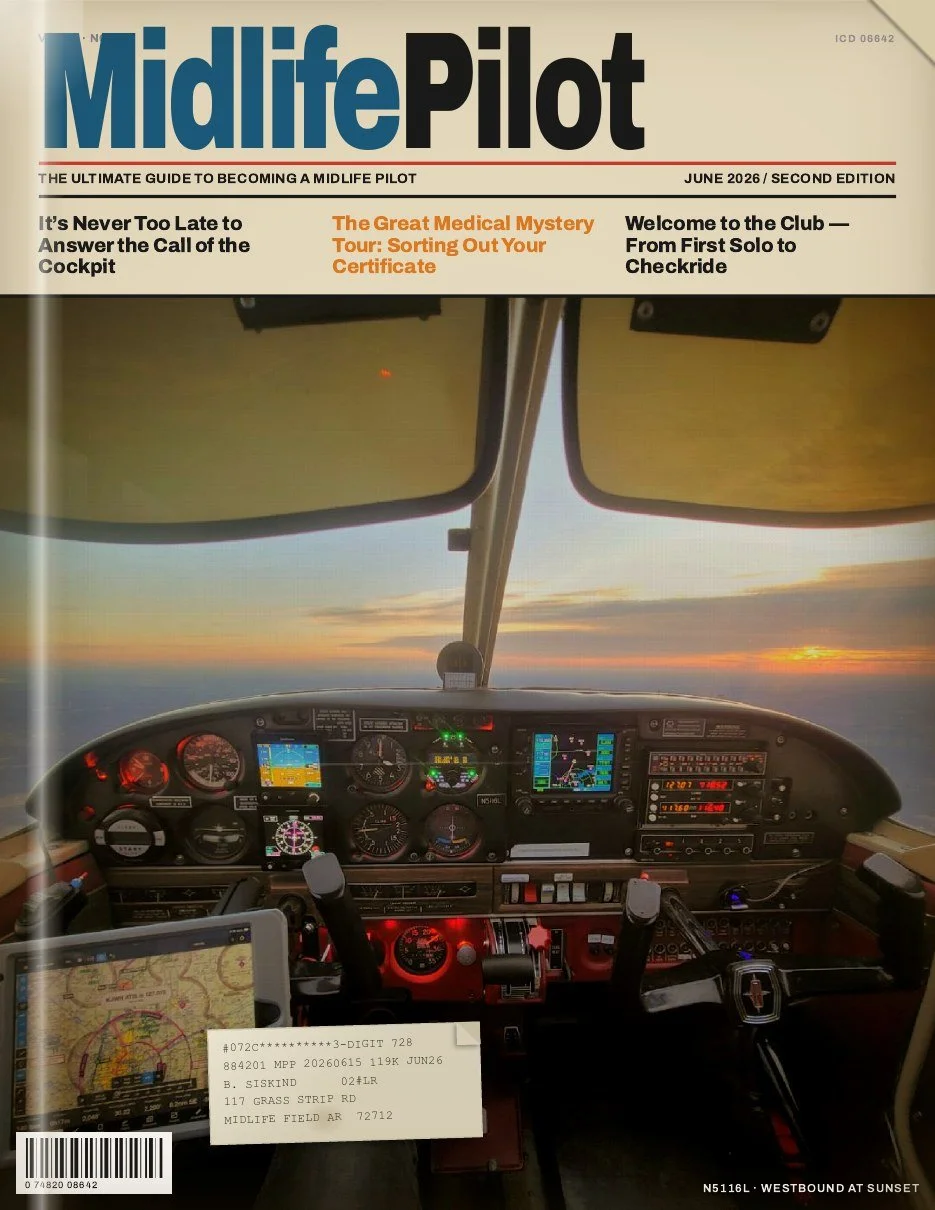
Get the free guide
Most of this post comes from The Ultimate Guide to Becoming a Midlife Pilot, Second Edition. It's 28 pages of hard-won wisdom from pilots who started at 40, 50, 60 and beyond. It covers certificates, the medical, training, money, time and what comes after the checkride.
It's free. No email required.
Keep listening
We walked through the whole guide on the show in a three-part series. Press play:
A few episodes for anyone on the fence:
EP200, It Took You Long Enough, live from McCollum Field
Once you're training, our aviation apps guide will help you set up your iPad.
The Midlife Pilot Podcast is on Apple Podcasts, Spotify and YouTube every week. We talk about the flying, the failing and the figuring it out. You'll fit right in.
We're pilots sharing experience, not flight instructors or medical examiners. For anything official, talk to a CFI, an AME, AOPA or the FAA.
Enjoying the read? Come fly along.
A weekly aviation podcast for people who took up flying in midlife. Real talk on learning to fly, growing as pilots, and the joy of general aviation.
